

Whether you are a repeat test taker who is facing nerves from a previous failure, or a first-time taker who has struggled with performance anxiety in the past, you are not alone in facing one of the biggest obstacles to passing the bar: exam room anxiety.
In my 20 years of coaching students to slay the dragon that is the California Bar Exam, I have seen the same pattern over and over again: brilliant law students who haven’t been able to pass the Bar because they freeze at exam time.
This is not a failure of intelligence. It is a biological event. As a certified performance coach, I teach my students how to conquer their anxiety in the exam room, so their knowledge and hard work can shine through and help them pass the bar.
If you have ever felt your mind go blank in a practice exam, you aren’t “weak.” You are experiencing a physiological reaction. You cannot think your way out of a panic attack. You have to act your way out of it.
Here is the science of what is happening to you, and three science-backed strategies to help you overcome the panic that is coming between you and your future career as a licensed attorney.
The Science: The “Amygdala Hijack”
When you stare at an essay prompt that looks unfamiliar, your brain perceives a threat. It doesn’t matter that it’s just paper; your ancient brain thinks it is a predator.
This triggers what psychologists call an Amygdala Hijack. Your amygdala (the fear center) screams “DANGER!” and dumps cortisol and adrenaline into your system. Crucially, it literally shuts down blood flow to your prefrontal cortex—the part of your brain responsible for logic, reasoning, and the IRAC method.
You aren’t forgetting the law because you didn’t study. You are forgetting it because your brain has entered “Fight or Flight” mode. You cannot IRAC a tiger. You have to reset your biology first.
Strategy 1: The Navy SEAL Reset (Box Breathing)
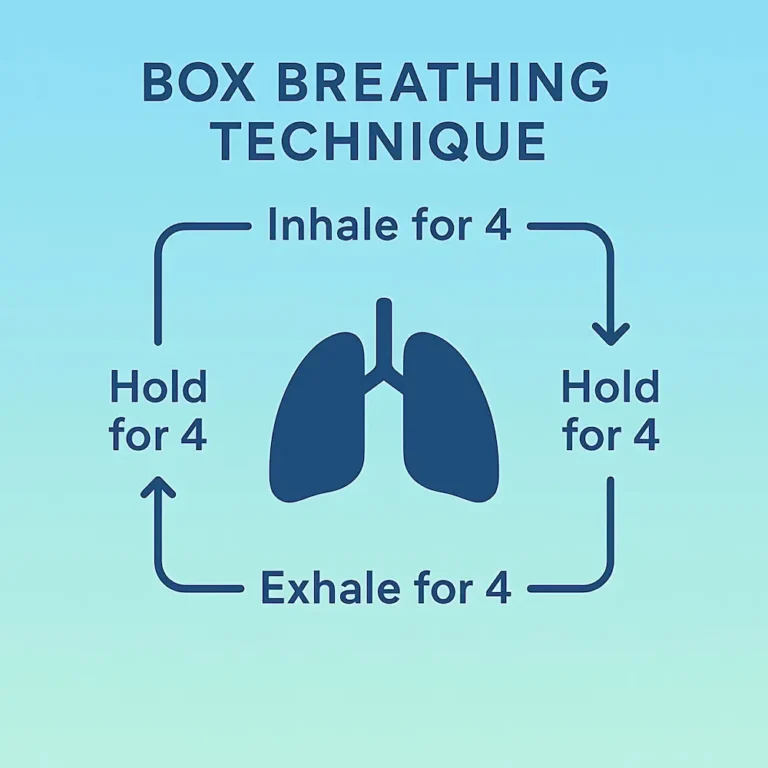
When the panic hits, your first instinct is to gasp for air or hold your breath. This only tells your brain the danger is real. To bring your prefrontal cortex back online, we use a technique used by Navy SEALs and first responders to stay calm in high-stakes situations: Box Breathing.
It is simple, mechanical, and tested.
- Inhale through your nose for a count of 4.
- Hold that breath for a count of 4.
- Exhale through your mouth for a count of 4.
- Hold the empty lungs for a count of 4.
Do this for just 60 seconds. This rhythm forces your parasympathetic nervous system (the “Rest and Digest” mode) to kick in, lowering your heart rate and reopening the door to your logical brain.
Strategy 2: Don’t “Calm Down”—Get Excited
This sounds counterintuitive, but it’s worked for many of my students.
When you feel that surge of adrenaline that causes your heart to race and your palms to sweat, your natural reaction is to force yourself to “calm down.”
But from a physiological standpoint, anxiety and excitement are almost identical. They both involve high arousal and a racing heart. Trying to go from “Panic” (High Arousal) to “Calm” (Low Arousal) is like trying to stop a speeding train by standing in front of it. You will get run over.
A famous study from Harvard Business School by Alison Wood Brooks found that people who reframed their anxiety as excitement performed significantly better on tests than those who tried to remain calm.
When you feel the shake, don’t fight it. Reframe it. Tell yourself: “My body is waking up. This energy is here to help me focus. I am excited to attack this essay.”
Ride the wave; don’t drown in it.
Strategy 3: Grounding (5-4-3-2-1)
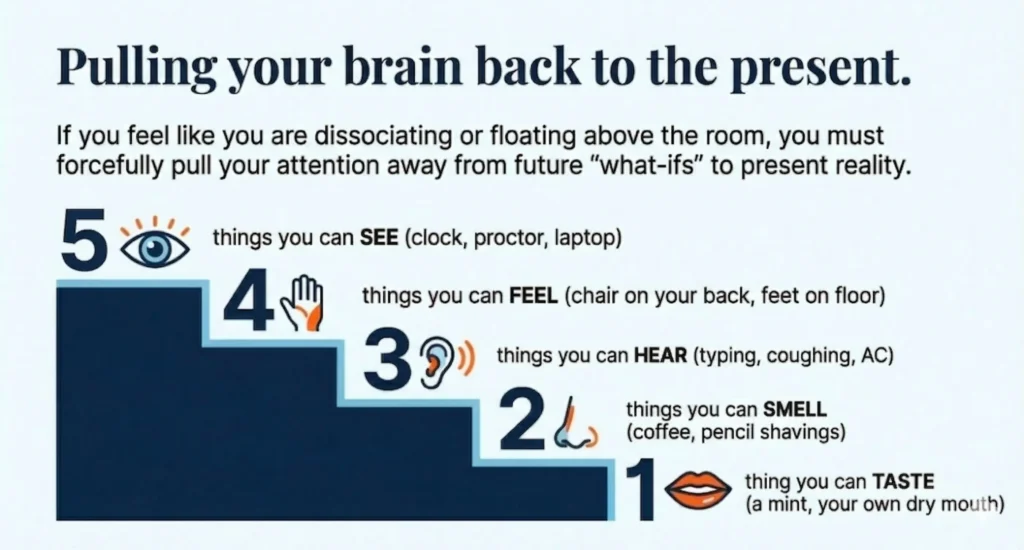
If you feel like you are completely dissociating—like you are floating above the room—you need to ground yourself in the physical reality of the exam center.
We use the 5-4-3-2-1 Technique to force your brain back into the present moment:
- 5 things you can see (The clock, the proctor, your laptop).
- 4 things you can feel (The chair against your back, your feet on the floor, the table).
- 3 things you can hear (Typing, coughing, the AC).
- 2 things you can smell (Coffee, pencil shavings).
- 1 thing you can taste (Your own dry mouth, a mint).
This methodically pulls your attention away from the “What ifs” (Future) and back to the “What is” (Present).
You Are A Warrior, and You Can Slay This Dragon
The California Bar Exam is a beast, but it is a beast that can be tamed.
I failed this exam twice before I figured out the right strategy to beat it. I learned that passing requires more than just knowing the rules—it requires managing your mindset. You have done the work. You have drilled down on the law. Now, trust your training.
If the panic comes, welcome it. Breathe through it. Use it.
You’ve got this, and if you want help from an experienced coach who has been there before, please reach out.