
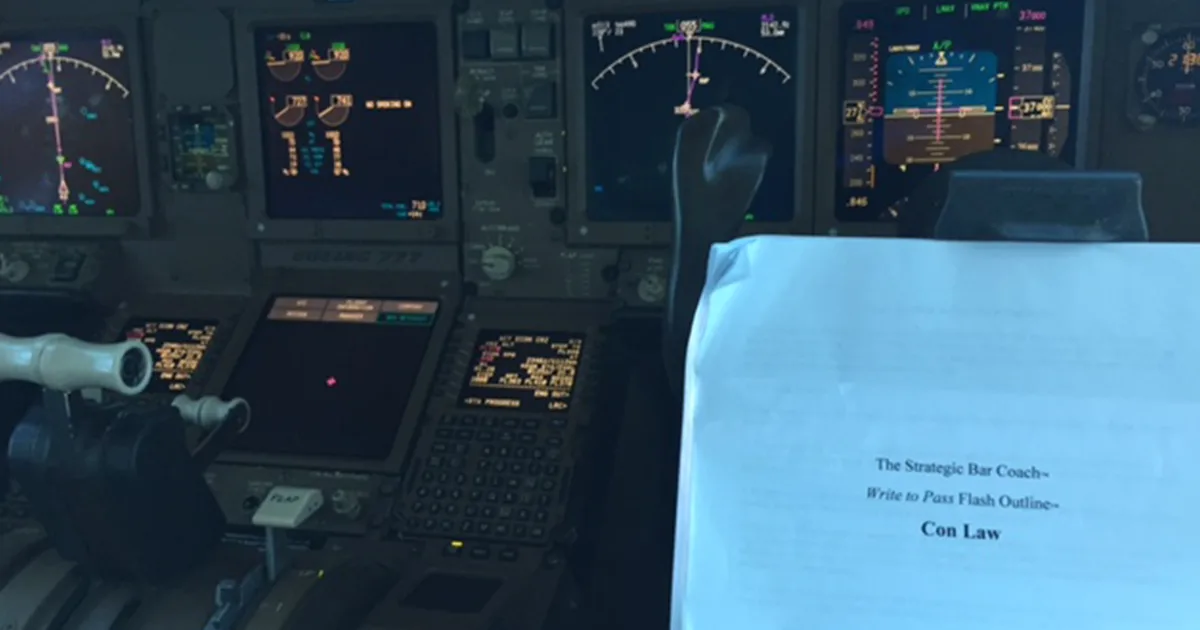
If you are preparing for the bar exam while holding down a full-time job, you are signing up for one of the most grueling marathons of your professional life. Over my years as an attorney and a bar exam tutor, I’ve helped hundreds of candidates attempt this balancing act. The picture in this blog post was sent to me by a student of mine who was also a pilot; as you can see, he had to find some creative places to study!
The difference between students who pass, and those who fall short, usually isn’t intelligence. It’s time management, boundary setting, and efficiency. When you are working 40, 50, or even 60 hours a week, the traditional “study for 10 hours a day” commercial bar prep model is not just unrealistic, but a recipe for severe burnout.
Here is how you actually survive, and conquer, the bar exam when your nine-to-five is paying the bills.
1. Ditch the Commercial Prep Pacing
Most big-box bar prep courses are designed for the traditional student who just graduated law school and has absolutely nothing else to do for ten weeks. If you try to keep up with their 100% completion trackers while working full time, you will inevitably fall behind, panic, and spiral.
Instead of treating the commercial schedule as gospel, treat it as a menu. You don’t have time for hours of passive video lectures on equitable servitudes or the history of the Rule Against Perpetuities. You need to practice your actual writing skills and doing actual MBEs. Your time is a premium currency, so spend it on active learning: answering essay questions, writing PTs, and drilling MBE questions.
2. Embrace the “Micro-Study” Session
When you work full-time, you will rarely have a solid four-hour block to dedicate to uninterrupted studying. You have to hunt for hidden time.
And, you can accomplish a lot in 20- or 30-minute bursts. Got a lunch break? Do ten MBE questions and review the explanations. It’s not ideal but it helps. Commuting on a train? Listen to an audio outline or review flashcards. Waiting for a meeting to start? Pull up a single essay prompt and issue-spot in your head. Over the course of a week, these micro-sessions add up to hours of highly effective, distributed practice. The brain actually retains information better in short, repetitive bursts than in marathon, exhaustion-fueled cram sessions.
3. Set Ruthless Boundaries at Work (and Home)
This is often the hardest thing to do for driven professionals. You have to train your employer, your colleagues, your family, and your friends that you are largely unavailable for a few months.
If you have a supportive employer, have a transparent conversation about your limits right now. Ask if you can shift your hours, front-load your week, or use PTO strategically in the final month leading up to the exam. If your employer is less forgiving, you need to become relentlessly efficient at work. Arrive, do your job well, and leave. This is not the season to volunteer for extra committees, stay late for office politics, or say “yes” to weekend projects. Your singular goal outside of maintaining your employment is passing the bar.
4. Focus on Output Over Input
When time is scarce, candidates often default to the easiest form of studying: reading outlines and highlighting notes. It feels productive, but it is entirely passive (what I like to call “input”).
To pass the bar exam, you need to train for “output.” The examiners don’t care how well you listened to a lecture; they care about your ability to answer multiple-choice questions under pressure and write coherent legal analysis. If you only have two hours to study after a long day at the office, make it count. Study the law (including my Exam Tips), exercise your writing muscles by doing Essays and PTs, and do a consistent number of MBEs learning from each MBE.
5. Protect Your Sleep at All Costs
There is a toxic myth in the legal profession that success requires sleep deprivation. I have seen brilliant, capable law school grads fail the bar exam simply because they were too exhausted to think clearly on exam day.
Staying up until 2:00 AM to memorize Constitutional Law and then waking up at 6:00 AM for work yields diminishing returns. Your brain consolidates memory during sleep. If you are chronically sleep-deprived, those hours of studying won’t stick. Aim for seven hours minimum. If you have to choose between an extra hour of sleep or an extra hour of studying, choose the sleep. You’ll be sharper, faster, and much more resilient the next day. This is especially important when it comes to doing MBEs which requires more intense focusing skills.
6. Don’t Do It Alone
Navigating this alone is incredibly tough. When your time is stretched thin, you can’t afford to waste time studying in an inefficient way. Working with a dedicated professional can help you cut through the noise, build a customized schedule that actually fits around your work hours, and hold you accountable to your goals.
Many candidates realize too late that a tailored approach is what they needed all along. When your career is on the line, finding the best bar exam tutor for your specific situation can be a complete game-changer. You need someone who can pinpoint your weaknesses quickly and teach you how to write passing essays without having to memorize a thousand pages of an outline.
You can pass the bar exam while working full time. It requires discipline, sacrifice, and above all, working smart. If you are looking for a strategic approach that respects your busy schedule and maximizes your limited hours, I invite you to visit www.strategicbarcoach.com. Let’s get you to the finish line, and make this bar exam your last!